Gondelaurier Mansion
The Hunchback of Notre DameGondelaurier Mansion is the center of a night-long vigil in which Quasimodo watches its windows and balcony, waiting for Phoebus de Châteaupers to emerge. Its festive, brightly lit interior stands in sharp contrast to the darkness outside, where Quasimodo remains alone; from his fixed post, he witnesses a private encounter between the captain and Fleur-de-Lys de Gondelaurier before following him into the street.
Setting and visible features
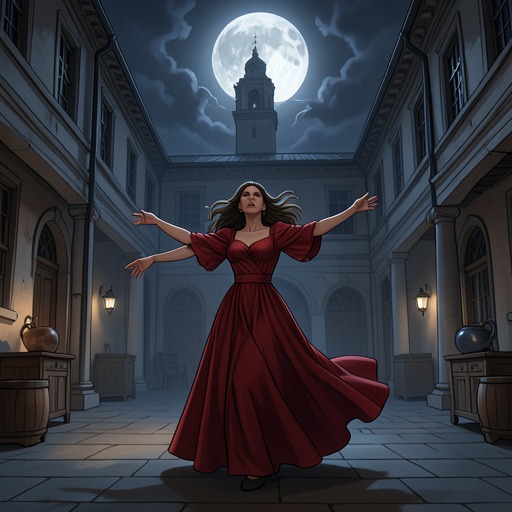
The mansion stands on a square near Notre-Dame Cathedral, with a porch where a handsome horse is hitched and a balcony above a stone balustrade. Quasimodo takes up his position against one of the porch’s stone posts, facing the house and able to look upward toward the roof, where Esmeralda remains in view. The scene gives the building a clearly divided aspect: the street-level porch and the upper balcony are visible from outside, while the rooms behind the windows remain inaccessible to the watcher.
The mansion’s windows mark the passage of the evening. Their lights appear one by one in the neighboring houses and then go out, but the mansion’s windows stay illuminated after midnight. Behind many-colored panes, shadows move in a lively, dancing throng. The description makes the interior legible as spectacle but not as conversation: Quasimodo can see figures, gestures, and changing light, yet he cannot hear what is said. His deafness sharpens the scene’s reliance on visual signs, including the lighted windows, silhouettes, clasped hands, and the changing visibility of the people on the balcony.
The vigil outside the house
Quasimodo waits because Phoebus has entered the mansion, and he is determined to remain until the captain comes out. The day passes without either watcher changing position: Quasimodo stays at the porch, while Esmeralda remains on the roof. As daylight fades, he can see her only as a pale shape against the twilight, and then not at all. The square grows dark; the other houses’ windows are extinguished, and Quasimodo is left alone outside while the mansion continues to shine.
The house’s festivities prolong his uncertainty. Guests begin to leave around one o’clock in the morning, passing through the torchlit porch, but none is Phoebus. Quasimodo keeps watching rather than abandoning his post. The mansion thus becomes a threshold between a gathering whose sounds and company he cannot share and the empty square where he waits for one specific person. Even the horse, first hitched at the door and later led to the house’s stable, marks time without bringing the departure he expects.
Balcony scene and departure
At last, a long window opening onto the balcony is opened, and two people pass through the frail glass door before it closes silently behind them. Quasimodo recognizes Phoebus and Fleur-de-Lys de Gondelaurier, whom he had seen welcome the officer from that same balcony in the morning. The place is now perfectly dark; a double crimson curtain falls across the closed door and prevents light from reaching the balcony. From below, Quasimodo cannot hear a word, but he can distinguish the pair’s gestures and expressions.
The captain and the young woman appear close: she allows his arm around her, then gently repulses a kiss. Their conversation grows more animated. Fleur-de-Lys seems to plead with Phoebus to ask no more of her; he looks ardently toward her while she turns her gaze to the stars, and their clasped hands and smiles mixed with tears supply the signs by which Quasimodo tries to understand them. The balcony door opens again, interrupting the encounter: an older woman appears, Fleur-de-Lys looks confused, and Phoebus displeased. The three withdraw inside.
A moment later Phoebus comes out beneath the porch, his night cloak around him, and passes Quasimodo. The bellringer lets him turn the street corner, then pursues him with his characteristic ape-like agility, calling, “Hey there! captain!” The mansion has not resolved Quasimodo’s vigil so much as set his next action in motion: after hours of watching a departure that never came, he follows the man he had been waiting for.
Narrative significance
The mansion’s architecture organizes the scene around distance and partial access. Quasimodo can watch from the porch and read the balcony’s visible gestures, but the curtain, darkness, and his deafness deny him the private words exchanged within. The bright windows make the house’s celebration conspicuous even as he remains outside it, and the contrast deepens when the surrounding square becomes dark and empty. The building is therefore not merely a backdrop for Phoebus’s visit; its porch, windows, and balcony structure a sequence of waiting, incomplete knowledge, and pursuit. What Quasimodo sees there consoles him briefly, but the encounter’s interruption and Phoebus’s swift departure lead directly to his attempt to catch up with the captain.